Culture & context
Hainanese Chicken Rice Origin & History
Hainanese chicken rice has roots in Wenchang chicken from Hainan, China. Hainanese migrants brought the tradition to Singapore, where it developed with local and Cantonese influences.
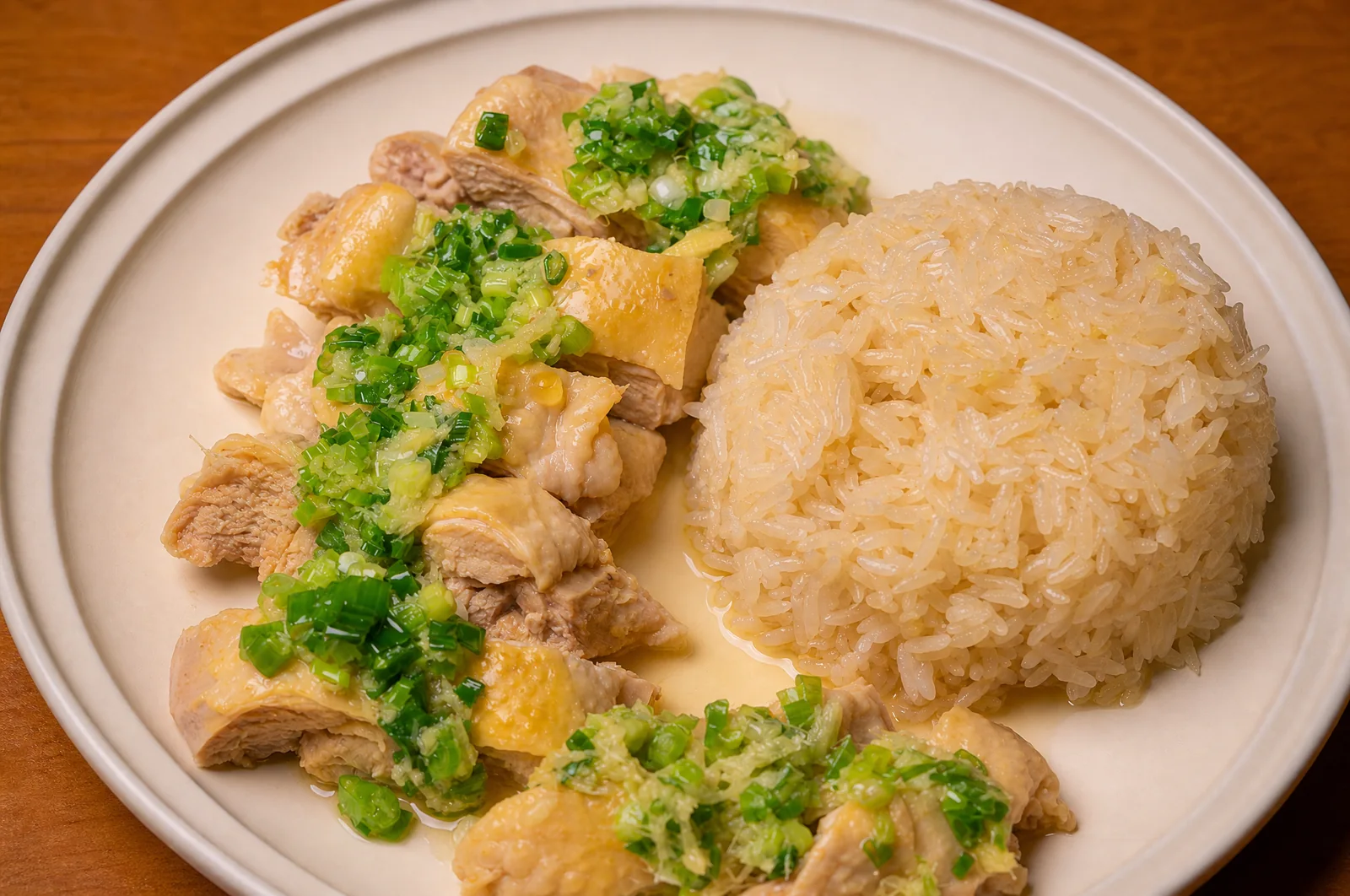
Where did Hainanese chicken rice originate?
Its roots lie in Wenchang chicken, a traditional dish from Hainan, China. The familiar Singapore-style chicken rice developed after Hainanese migrants brought that food tradition to Singapore.
Singapore's National Library Board traces the dish to boiled Wenchang chicken. The National Heritage Board's chicken rice history describes how Cantonese preparation techniques and local ingredients, including pandan in the rice, helped shape the dish in Singapore. Hainan explains its roots; Singapore is an important part of its later development.
What is Hainanese chicken rice?
Hainanese chicken rice is a complete dish built around poached chicken and fragrant rice cooked with chicken broth and fat.
It is commonly served with cucumber, clear chicken soup, and condiments such as chile sauce and soy sauce; this site’s Singapore-style plate also includes ginger-scallion sauce. On this site, “Hainanese chicken” refers to the chicken component, while “Hainanese chicken rice” means the complete plate.
Is Hainanese chicken rice Chinese?
It has Chinese roots, but the familiar modern dish is also a Southeast Asian migrant adaptation.
Singapore’s National Heritage Board credits the Hainanese community with introducing the dish to Singapore and says it evolved from Wenchang chicken from Hainan, China. Cantonese techniques and local ingredients then helped shape the version now familiar in Singapore.
Hainan roots, Southeast Asian development
The route from Hainan to Singapore explains why the dish can be rooted in a Chinese island tradition and still be recognized as part of Singapore’s food heritage.
Hainanese immigrants brought food knowledge with them in the nineteenth and early twentieth centuries, then adapted it to local kitchens, ingredients, customers, and neighboring techniques.
The Singapore plate kept changing
Hainanese base
Poached chicken and seasoned rice connect the dish to Wenchang chicken traditions.
Cantonese influence
Younger birds and ice-water treatment are described as later Cantonese contributions.
Local expression
Pandan, chile sauce, cucumber, broth, and stall-specific condiments shaped the familiar plate.
Poached, roasted, and soy-sauce versions now coexist in Singapore. This site focuses on Singapore-style poached chicken rice, one expression of a wider food tradition.
Regional relatives deserve their own names
Chicken rice is common in Singapore and Malaysia, with related traditions in Thailand, Vietnam, and Indonesia. Thai khao man gai, for example, has its own sauce language and should not be treated as an incorrect copy of a Singapore plate.
Editorial position
We do not claim that one country owns every version, that one stall invented the entire tradition, or that a single family formula can settle a regional history.
Primary context: Singapore National Heritage Board, “Chicken Rice” and National Library Board, “We Are What We Eat: The Evolution of Chinese Food in Singapore”.